
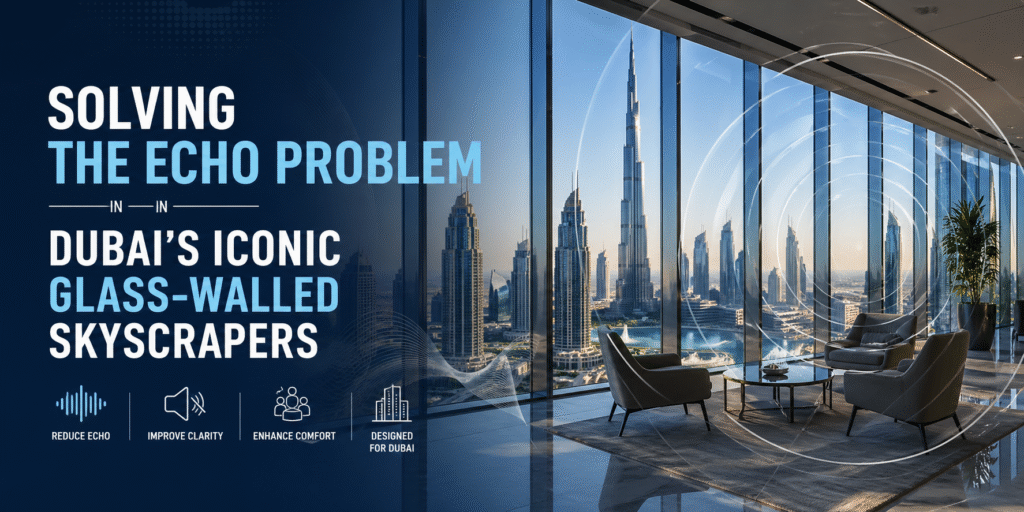
Dubai’s skyline is one of the most photographed on earth. The city’s defining buildings — towers of glass and steel that catch the light differently at every hour, represent an architectural ambition that few cities can match. But inside these structures, a persistent acoustic problem undermines the quality of the spaces they contain.
Glass-walled buildings are acoustically unforgiving. The same curtain wall glazing that creates panoramic views and floods interiors with natural light also generates extreme reverberation that degrades speech clarity, amplifies mechanical noise, and makes floors, boardrooms, and hospitality spaces far less comfortable than their visual quality suggests. In Dubai, where the density of high-specification commercial and residential towers is among the highest in the world, this is not a minor inconvenience. It is a design challenge that requires dedicated acoustic panel solutions.
Why Glass-Walled Buildings Generate Such Extreme Echo
The Physics of Sound in an All-Glass Environment
When sound is produced in a room, it travels outward in all directions. In a space with absorptive surfaces — carpeted floors, upholstered furniture, heavy curtains — much of that energy is captured quickly, and the room feels quiet and controlled. In a glass-walled space, almost none of the sound energy is absorbed on first contact. Glass has a sound absorption coefficient close to zero. Sound bounces off the facade, off the polished concrete or stone floor, off the exposed ceiling soffit, and continues to reflect until it eventually loses energy through air friction alone.
The result is a reverberation time that can exceed three seconds in large open-plan floors — a figure more than three times longer than what acoustic standards recommend for office environments. In such conditions, multiple speakers in a room become unintelligible. Video conferencing is rendered unreliable. And the constant background wash of reflected noise raises stress levels and reduces concentration throughout the working day.
Why Dubai’s Buildings Face This Problem More Acutely
Dubai’s built environment intensifies the acoustic challenge in several specific ways. The city’s design culture favours large floor plates with minimal internal subdivision, creating vast open-plan spaces with uninterrupted sightlines — and uninterrupted sound travel. Tower floors frequently feature polished marble or engineered stone, exposed ceiling services, and double-height atrium spaces. The combination of extreme floor-to-ceiling heights, continuous glazed facades, and hard finish specifications creates acoustic environments that require systematic treatment rather than isolated remedial measures.
Where the Echo Problem Manifests in Dubai’s Commercial Towers
Corporate Office Floors and Open-Plan Workspaces
Open-plan office floors in Dubai’s commercial towers are among the most acoustically compromised working environments in the built environment. With glazed perimeters on two or more sides, exposed ceilings, and hard flooring, these floors generate reverberation times that make focused work difficult and collaborative discussion frustrating. Research consistently shows that excessive noise in office environments reduces productivity, increases error rates, and contributes to employee fatigue. For businesses paying premium rents for premium floor space, the acoustic performance of that space has a direct impact on the return on investment.
Hotel Lobbies and Hospitality Spaces
Dubai’s hospitality sector operates at the highest international standard, and the guest experience in a hotel lobby or restaurant is a direct reflection of the brand. Glass facades and double-height atriums are design signatures across the city’s landmark hospitality properties. In these spaces, reverberation makes conversation effortful, amplifies ambient operational noise, and creates an environment that works against the sense of calm and luxury the design is meant to convey. Acoustic treatment in hospitality spaces must solve the problem without visible compromise to the interior design — a challenge that acoustic panels in Dubai are increasingly being specified to address.
Residential Towers: Living With the View
Dubai’s residential tower market has seen a decade of growth in the ultra-premium segment, with apartments and penthouses specified to the highest international standards. In these units, the same glazed facade that commands a premium price creates an acoustic environment that undermines residential comfort. Floor-to-ceiling windows, open-plan living areas, and hard finish packages all compound the problem. For high-net-worth residents who have invested significantly in their living environment, the acoustic quality of a space is increasingly a design priority rather than an afterthought.
How Acoustic Panels Solve the Echo Problem in Glass-Walled Buildings
Strategic Surface Treatment: Where to Place Acoustic Panels
The principle behind acoustic panel placement in a glass-walled building is straightforward: introduce absorptive surfaces at the points where sound energy would otherwise be reflected and amplified. In practice, this means targeting the surfaces that hard-surfaced buildings lack — treating wall sections, ceiling planes, and any vertical surface adjacent to the glazed facade.
Effective acoustic panel placement in a commercial tower floor typically includes:
- Ceiling-mounted acoustic cloud panels positioned above high-activity zones such as collaboration areas and reception desks.
- Wall-mounted acoustic panels on the internal partition walls and core walls that face the glazed perimeter.
- Acoustic treatment within meeting rooms and conference facilities, where speech intelligibility is critical.
- Baffles and suspended panels in atrium spaces to reduce vertical reverberation in double-height environments.
Panel Selection for Dubai’s Climate and Specification Standards
Acoustic panels specified for Dubai’s built environment must meet requirements that extend beyond acoustic performance alone. The city’s building standards demand Class A fire-rated materials across commercial and hospitality applications. The climate — extreme heat, high humidity in coastal locations, and prolonged air conditioning operation — means panels must perform consistently without degrading. And the city’s design culture means that acoustic panels must be available in a range of finishes, colours, and custom configurations that align with high-specification interior design briefs.
Polyester fibre acoustic panels and fabric-wrapped mineral wool panels meet these requirements comprehensively. They are available in fire-rated variants, perform consistently in climate-controlled environments, and offer the design flexibility that Dubai’s specification market expects.
Acoustic Panels in Meeting Rooms and Conference Facilities
Meeting rooms and boardrooms in Dubai’s commercial towers represent a specific and high-priority acoustic challenge. These are the spaces where the quality of communication has the most direct commercial consequence — where client presentations are delivered, deals are negotiated, and executive decisions are made. Poor speech intelligibility in a boardroom is not an inconvenience; it is a professional liability.
Acoustic treatment in these spaces typically combines wall panels at first reflection points, ceiling treatment above the conference table, and rear wall absorption to control the long reverberation tail. The result is a room where every participant can be heard clearly, video conferencing systems function reliably, and the acoustic environment supports rather than obstructs the work being done.
The Business Case for Acoustic Panel Investment in Dubai’s Buildings
The conversation around acoustic panels in Dubai has shifted significantly in recent years. Developers and fit-out teams increasingly understand that acoustic performance is not a luxury specification — it is a measurable factor in tenant satisfaction, lease renewal rates, and the marketability of commercial and residential space.
In a market as competitive as Dubai’s, where tenants and buyers have access to high-quality alternatives at every price point, the sensory quality of a space — including its acoustic environment — is a genuine differentiator. Buildings that have been acoustically treated retain tenants more effectively, command higher occupancy rates, and position themselves more convincingly in the premium segment of the market.
For developers, fit-out contractors, and interior designers working across Dubai’s commercial and residential tower market, the acoustic panel is no longer a finishing detail. It is a core component of a specification that aims to deliver spaces that perform as well as they look. Companies like Acoustic Dubai by akinco have developed product ranges and installation expertise specifically for the demands of this market — combining the performance credentials required by international acoustic standards with the design flexibility that Dubai’s built environment demands.
Frequently Asked Questions
Why do glass-walled buildings in Dubai have such bad acoustics? Glass has a near-zero sound absorption coefficient, meaning it reflects almost all sound energy that strikes it. Combined with hard flooring, exposed ceilings, and large open floor plates, glass-walled buildings generate very long reverberation times — often exceeding three seconds in commercial spaces. This makes speech unclear, amplifies background noise, and creates an environment that is uncomfortable and tiring to work or live in.
What types of acoustic panels are best suited for commercial towers in Dubai? For Dubai’s commercial environment, Class A fire-rated polyester fibre panels and fabric-wrapped mineral wool panels are the most commonly specified options. They meet UAE building code requirements for fire safety, perform reliably in climate-controlled environments, and are available in custom colours and finishes that align with high-specification interior design briefs.
How much of a room’s surface area needs acoustic panel coverage to make a difference? In a highly reflective glass-walled environment, treating 25 to 40 percent of available wall and ceiling surface area with absorptive panels will typically reduce reverberation time to within the range recommended for office and commercial use (0.4 to 0.8 seconds). An acoustic consultant can model the specific requirements for each space based on room volume, surface finishes, and intended use.
Can acoustic panels be installed without disrupting an occupied office in Dubai? Yes. Most acoustic panel systems — including ceiling cloud installations and wall-mounted panels — can be installed outside core working hours with minimal disruption to occupants. Many systems use mechanical fixings or tensioned track systems that do not require wet trades or extended installation periods.
Do acoustic panels in Dubai need to meet specific fire rating requirements? Yes. UAE building regulations and Dubai Civil Defence requirements mandate Class A fire-rated materials in commercial, hospitality, and multi-occupancy residential buildings. Always confirm fire rating certification with the panel supplier and ensure that the specification is documented for the building’s compliance file.
How long does it take to see the acoustic benefit after panels are installed? The acoustic improvement is immediate. As soon as absorptive panels are in place, reverberation time decreases and speech clarity improves. There is no settling-in period. The extent of the improvement depends on the coverage area and the acoustic properties of the panels specified, but in typical glass-walled commercial spaces, a well-executed installation produces a clearly audible difference from day one.