
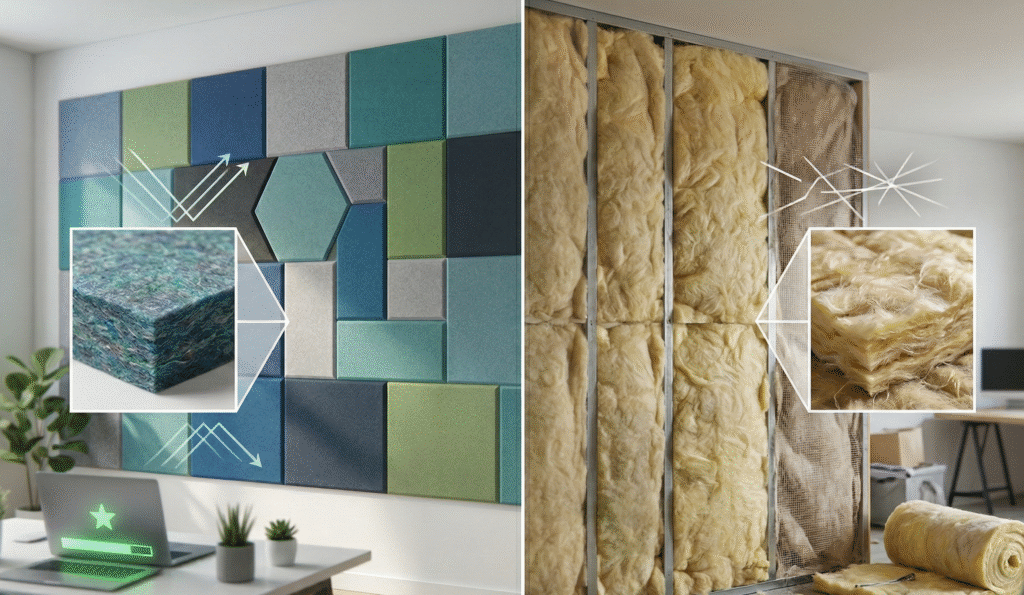
The acoustic treatment decision extends far beyond simple performance calculations. Material selection profoundly impacts installer safety, occupant health, environmental footprint, long-term costs, and aesthetic possibilities. For decades, fiberglass dominated acoustic treatment markets through inertia, established specifications, and familiarity despite significant drawbacks becoming increasingly unacceptable in modern building practices prioritizing health, safety, and sustainability.
Polyester fiber panels represent evolutionary leap forward addressing fiberglass shortcomings while matching or exceeding acoustic performance. The comparison between these materials reveals dramatic differences in safety characteristics, environmental impacts, durability, and user experience extending far beyond acoustic specifications. Understanding these distinctions enables informed decisions aligning material selection with organizational values and project priorities.
This comprehensive comparison examines polyester fiber panels and fiberglass acoustic panels across every relevant dimension. From health and safety considerations through acoustic performance, durability, environmental impact, installation experience, cost analysis, and aesthetic possibilities, you’ll gain complete understanding necessary for confident material specification. The evidence clearly demonstrates why polyester panels increasingly displace traditional fiberglass in acoustic applications worldwide.
Understanding Both Materials
What Are Polyester Fiber Panels?
Polyester fiber panels consist of thermoplastic polyester polymer fibers compressed into rigid or semi-rigid acoustic panels through thermal bonding processes. The manufacturing typically begins with post-consumer recycled PET (polyethylene terephthalate) collected through recycling programs, primarily plastic bottles diverted from landfills. These bottles undergo cleaning, grinding into flakes, heating, and extrusion creating continuous polyester fibers.
The fibers are laid in random orientations and compressed under heat and pressure forming cohesive panels without chemical binders or adhesives. This thermal bonding process creates structurally sound panels maintaining shape and performance characteristics throughout decades of service. The resulting material exhibits consistent density throughout panel thickness, typically ranging from 80 to 120 kilograms per cubic meter depending on intended application and performance requirements.
Physical characteristics include firm yet slightly flexible feel allowing some conformity to mounting surfaces while resisting permanent deformation. Colors penetrate throughout material depth rather than existing as surface coatings, preventing visible wear from minor surface damage. Panel surfaces exhibit slight texture providing contemporary technical character. The material feels warm to touch unlike cold glass fiber surfaces, creating more inviting installations in occupied spaces.
Manufacturing processes operate at substantially lower temperatures compared to glass fiber production, typically 200 to 300 degrees Celsius versus 1400 plus degrees required melting sand into glass. This dramatic temperature difference translates to significantly lower energy consumption and reduced carbon emissions. The closed-loop thermal bonding process generates minimal waste with production scraps recycled directly back into manufacturing streams.
What Are Fiberglass Acoustic Panels?
Fiberglass acoustic panels contain fine glass fibers bonded together using resins or mechanical compression forming porous acoustic materials. Manufacturing begins with silica sand and other raw materials melted at extremely high temperatures exceeding 1400 degrees Celsius. The molten glass extrudes through small openings creating fine fibers that cool and solidify into hair-like glass strands.
These glass fibers collect and compress into panels using phenolic or other resin binders holding fibers together. Some products use mechanical compression without binders though these typically exhibit lower structural integrity. The manufacturing process consumes significant energy from high temperature requirements and typically uses virgin raw materials rather than recycled content.
Physical characteristics include relatively rigid structure that may compress under load or sag over time, especially in humid environments. Glass fibers create rough, slightly brittle surface that can shed fine particles when handled or cut. The material feels cold to touch and exhibits distinctive fiberglass appearance familiar from insulation products. Panel surfaces typically require fabric facing or other protective covering for acceptable appearance in architectural applications.
Historical dominance in acoustic treatment industries stems from early development, established manufacturing infrastructure, widespread availability, and specification inertia perpetuating traditional material selection despite emerging alternatives. Performance proven over decades created comfort level among specifiers reluctant to try new materials even when superior options became available. Cost advantages from mature manufacturing and commodity pricing sustained market position despite growing awareness of health and environmental concerns.
Head-to-Head Comparison
Safety and Health Comparison
Polyester Advantages:
Complete absence of skin and respiratory irritation distinguishes polyester fiber panels as dramatically safer material for handlers and building occupants. The thermoplastic polyester fibers contain no sharp edges or abrasive surfaces capable of penetrating skin or mucous membranes. Workers handle panels comfortably without protective equipment beyond standard construction safety gear. No itching, no skin redness, no respiratory irritation occurs from polyester panel exposure regardless of duration.
Airborne fiber generation during cutting, drilling, or handling remains essentially zero. Unlike glass fibers that fracture into progressively smaller particles becoming airborne and respirable, polyester fibers maintain integrity. Cutting polyester with utility knives creates clean cuts without generating dust clouds. Installation proceeds cleanly without airborne particulate concerns. This characteristic makes polyester appropriate for occupied renovations where building inhabitants remain present during installation.
No protective equipment requirements beyond basic construction safety including eye protection and work gloves if desired dramatically simplify installation logistics and reduce costs. Installers work comfortably without respirators, full coverage clothing, or specialized ventilation. This comfort improves productivity, reduces labor costs, and expands the available workforce to general contractors rather than requiring specialized crews willing to work with irritating materials.
Safety for all building types including schools, healthcare facilities, and residences makes polyester universally appropriate. Children’s developing respiratory systems, patients with compromised health, and families living in treated spaces face no health concerns from polyester panel presence. The material contains no substances requiring special handling, disposal, or long-term monitoring. Complete safety profile eliminates liability concerns that increasingly affect fiberglass specifications in sensitive applications.
Hypoallergenic properties ensure polyester panels cause no allergic reactions even in sensitive individuals. The inert thermoplastic material contains no proteins, VOCs, or other substances triggering immune responses. Occupants with chemical sensitivities tolerate polyester panels without difficulty. This universal compatibility makes specification straightforward without health accommodation requirements.
Fiberglass Concerns:
Skin irritation from glass fiber contact represents immediate, obvious fiberglass drawback affecting everyone handling material. Fine glass particles penetrate skin creating mechanical irritation that itches intensely and persists hours after exposure ends. Washing removes surface particles but embedded fibers continue irritating until naturally worked out over days. Repeated exposure causes cumulative irritation and some individuals develop heightened sensitivity with continued contact.
Respiratory irritation potential from airborne glass particles concerns workers and occupants. Cutting or handling fiberglass releases fine particles that remain airborne for extended periods. Inhalation causes throat and lung irritation manifesting as coughing, scratchy throat, and respiratory discomfort. While acute exposure causes temporary irritation, long-term health effects from chronic exposure remain debated with some studies suggesting potential concerns though regulatory agencies have not classified fiberglass as carcinogenic.
Protective equipment requirements including long sleeves, gloves, respirators, and eye protection prove cumbersome, uncomfortable, and expensive. Workers must fully cover skin preventing direct fiberglass contact. Respirators filter airborne particles preventing inhalation. These requirements slow installation, increase labor costs, and limit the workforce to those willing to work under protective equipment constraints. Equipment costs add to project expenses while disposal of contaminated protective gear creates waste.
Not recommended for DIY installation in sensitive environments including homes, schools, or healthcare facilities due to health concerns and specialized handling requirements. Homeowners attempting fiberglass installation often experience severe discomfort from inadequate protection or lack of awareness regarding necessary precautions. Professional installation becomes nearly mandatory adding costs that might otherwise be avoided through DIY execution using safer materials.
Ongoing particle concerns about airborne fiberglass particles throughout material service life raise questions about long-term indoor air quality impacts. Damaged fiberglass panels may shed particles into occupied spaces. Plenum installations where air circulates through fiberglass raise concerns about particle entrainment into breathing air. While studies show low particle concentrations from properly installed fiberglass, sensitivity to any particle release drives specifications toward completely inert alternatives.
Performance Comparison
Sound Absorption Capabilities:
NRC (Noise Reduction Coefficient) ratings for both polyester and fiberglass panels typically range from 0.85 to 1.00 in appropriate configurations, indicating both materials absorb 85 to 100 percent of sound energy striking their surfaces across speech frequency ranges. This performance parity means acoustic considerations alone don’t determine material selection as both materials deliver excellent sound absorption when properly specified. Testing according to ASTM C423 standards confirms comparable performance between materials of equivalent density and thickness.
Frequency absorption characteristics show both materials excelling at mid and high frequencies (500 to 4000 Hz) where most speech and environmental noise occurs. Low frequency absorption depends primarily on material thickness for both materials following physics principles requiring porous depth approximating one-quarter wavelength for optimal absorption. A 250 Hz tone with 1.37 meter wavelength suggests 340 millimeter optimal depth though practical panels use 25 to 50 millimeter thickness providing good rather than perfect absorption.
Thickness requirements for equivalent performance remain essentially identical between materials. Twelve-millimeter polyester and fiberglass panels deliver similar mid-high frequency absorption. Twenty-five-millimeter thickness extends effective absorption to approximately 250 Hz for both materials. Fifty-millimeter panels address bass frequencies comparably. This thickness equivalence means panel depth requirements don’t vary based on material selection, simplifying architectural integration.
Density impact on performance follows similar patterns with both materials benefiting from optimal density ranges. Too low density allows sound to pass through without adequate absorption. Excessive density prevents sound penetration creating surface reflection rather than absorption. Optimal density ranges of 80 to 100 kilograms per cubic meter for both materials deliver balanced performance across frequency spectrum. This similarity reflects fundamental acoustic absorption principles rather than material-specific characteristics.
Performance Specifications Table:
| Specification | Polyester Fiber | Fiberglass |
|---|---|---|
| NRC Range | 0.85-1.0 | 0.85-1.0 |
| Low Frequency (125-250 Hz) | Good (with adequate thickness) | Good (with adequate thickness) |
| Mid Frequency (500-1000 Hz) | Excellent | Excellent |
| High Frequency (2000-4000 Hz) | Excellent | Excellent |
| Thickness for equivalent performance | 12mm, 25mm, 50mm standard | 12mm, 25mm, 50mm standard |
| Density for optimal performance | 80-100 kg/m³ | 80-100 kg/m³ |
This performance equivalence demonstrates that acoustic considerations don’t differentiate materials. The decision factors center on safety, environmental impact, durability, installation experience, and long-term value rather than acoustic capabilities where materials perform essentially identically.
Durability and Longevity
Polyester Superior Long-Term Performance:
Sag resistance throughout service life distinguishes polyester from fiberglass prone to deformation over time. The thermoplastic polyester structure maintains dimensional stability indefinitely under normal indoor conditions. Panels mounted vertically on walls remain flat without bowing or warping. Ceiling installations resist gravitational sagging that sometimes affects fiberglass panels, especially large formats or high humidity environments. This dimensional stability maintains both acoustic performance and aesthetic appearance throughout 20 to 30 year service lives.
Shape retention under various conditions including temperature cycling, humidity variations, and physical stress ensures consistent appearance and performance. Polyester’s thermoplastic nature provides resilience allowing recovery from minor compression. Temporary loads compress panels slightly with full recovery after load removal. This resilience prevents permanent deformation from incidental contact or handling during installation.
Moisture resistance protects polyester panels in humid environments where fiberglass may degrade. The hydrophobic polyester fibers shed moisture rather than absorbing it. Even in high humidity spaces including locker rooms, natatoriums, or tropical climates, polyester panels resist mold growth, maintain structural integrity, and preserve acoustic properties. Quick drying after moisture exposure prevents water damage compromising performance.
Service life expectancy of 20 to 30 years for polyester panels exceeds typical fiberglass lifespan of 15 to 20 years, though well-installed fiberglass in favorable conditions may approach polyester longevity. The difference stems from polyester’s superior resistance to environmental factors causing gradual fiberglass degradation. Over building ownership timelines spanning decades, this longevity difference affects replacement cycles and life cycle costs substantially.
Color stability throughout service life maintains aesthetic appeal as polyester resists UV-induced fading substantially better than many alternatives. Colors remain vibrant and true to original specifications for decades rather than becoming faded and dingy. This appearance retention proves particularly valuable in high-visibility applications where aesthetic presentation affects space quality and organizational image throughout building life.
Fiberglass Durability Limitations:
Potential sagging over time, especially in humid environments or large panel installations, represents primary fiberglass durability concern. Glass fibers lack inherent resilience causing permanent deformation under sustained loads including panel weight and gravity. Ceiling installations prove most vulnerable with large format panels exhibiting visible sagging after years of service. High humidity accelerates degradation by affecting binder systems holding glass fibers together.
Compression under sustained loads reduces panel thickness and acoustic effectiveness. Glass fibers crushed by compression don’t recover creating permanent performance degradation. Areas subject to contact or leaning loads show visible compressed zones. This compression susceptibility requires careful installation avoiding conditions causing long-term loading.
Moisture sensitivity affects binder systems and promotes degradation in humid conditions. While glass fibers themselves resist moisture, organic binders may degrade from prolonged humidity exposure. Moisture accumulation within panels may support mold growth on binder materials creating health concerns and visible discoloration. Fiberglass installations in consistently humid environments require particular attention to moisture control.
Typical service life of 15 to 20 years under normal conditions proves adequate though shorter than polyester alternatives. Well-maintained fiberglass in favorable conditions may serve longer while installations in challenging environments degrade more rapidly. The shorter lifespan necessitates earlier replacement consideration affecting life cycle costs and disruption from renovation projects.
Color fading potential from UV exposure and environmental factors affects aesthetic longevity. Fabric facings protecting fiberglass cores may fade or discolor from sunlight, dust accumulation, or air pollutants. The gradual appearance degradation eventually necessitates replacement or recovering even when acoustic performance remains adequate. This aesthetic aging creates image problems in high-visibility installations.
Environmental Impact
Polyester Environmental Advantages:
Recycled content typically ranging from 60 to 100 percent post-consumer material diverted from landfills and oceans represents polyester’s most compelling environmental credential. Each square meter of 25-millimeter thick panel contains approximately 80 to 100 plastic bottles transformed from waste into high-performance building product. This tangible recycling impact demonstrates circular economy principles converting single-use packaging into durable goods serving decades before potentially recycling again.
Recyclable at end of life after 20 to 30 years of service, polyester panels avoid landfill disposal through reprocessing into new panels or other polyester products. The thermoplastic material melts and reforms indefinitely without quality degradation. Some manufacturers operate take-back programs accepting old panels ensuring proper recycling. This closed-loop potential exemplifies sustainable material management.
Lower embodied energy from reduced manufacturing temperatures and recycled feedstock reduces carbon footprint compared to virgin material production. Manufacturing polyester panels at 200 to 300 degrees Celsius consumes dramatically less energy than melting sand at 1400 plus degrees for glass fiber. Life cycle assessment consistently shows polyester panels exhibiting 40 to 60 percent lower embodied energy than fiberglass equivalents.
No harmful emissions during manufacturing or throughout service life makes polyester panels exemplary low-impact building products. VOC testing consistently shows zero or near-zero emissions. No formaldehyde, no chemical off-gassing, no toxic substances release into occupied spaces. The clean emission profile supports LEED and other green building certifications rewarding low-emitting materials.
LEED contribution through multiple credit categories including recycled content, low-emitting materials, and construction waste reduction enables point accumulation toward certification. Projects pursuing environmental recognition benefit substantially from polyester specification. The material supports sustainability goals while delivering required acoustic performance without compromise.
Fiberglass Environmental Concerns:
Virgin materials typically used in fiberglass production consume natural resources without recycling benefits. While some manufacturers incorporate recycled glass content, most fiberglass uses silica sand and other virgin raw materials. The extraction and processing of these materials creates environmental impacts from mining, transportation, and energy-intensive processing.
Difficult to recycle at end of life due to glass fiber contamination concerns and limited recycling infrastructure. Mixed material streams combining glass fibers with resin binders complicate recycling efforts. Most fiberglass panels reaching end of life enter landfills rather than recycling streams. The disposal creates waste burden without material value recovery.
Higher embodied energy from extreme manufacturing temperatures and virgin material processing increases carbon footprint. Melting sand requires sustained temperatures exceeding 1400 degrees Celsius consuming enormous energy. The high temperature processing combined with virgin material extraction creates substantial carbon emissions per kilogram of finished product. Life cycle studies consistently show higher environmental impact compared to recycled content alternatives.
Formaldehyde concerns in some products using phenolic or urea-formaldehyde binders raise indoor air quality questions. While modern formaldehyde-free binders exist, legacy products and some current manufacturing continues using formaldehyde-containing systems. The potential off-gassing affects indoor air quality particularly during initial installation periods. Specification requires careful attention to binder chemistry and emissions testing.
Limited sustainability credentials compared to recycled-content alternatives reduce appeal in green building projects. Without meaningful recycled content, closed-loop recyclability, or emissions advantages, fiberglass struggles meeting increasingly stringent sustainability requirements. Projects pursuing environmental certifications face challenges accumulating necessary points when specifying traditional fiberglass over sustainable alternatives.
Installation Comparison
Polyester Installation Advantages:
Easy handling without protection enables comfortable, efficient installation. Workers handle panels bare-handed without itching, irritation, or discomfort. The pleasant handling experience improves productivity, reduces labor costs, and expands available workforce to general contractors rather than requiring specialized crews. Installers maintain consistent pace throughout projects without fatigue from protective equipment or discomfort from material exposure.
Clean cutting with standard tools produces minimal mess without airborne particles requiring extensive cleanup. Sharp utility knives slice through polyester cleanly. Cutting generates no dust clouds, no airborne fibers, no respiratory concerns. The clean process enables cutting in occupied spaces without health concerns or extensive containment measures. Installation proceeds without elaborate protection, containment, or cleanup requirements.
No itching or irritation during or after installation eliminates common fiberglass installation misery. Workers complete projects comfortably without scratchy skin, watering eyes, or respiratory discomfort persisting hours after work ends. This comfort difference proves dramatic for anyone who has experienced both materials, with polyester installation described as pleasant compared to fiberglass described as miserable.
Suitable for DIY installations enables homeowners and facility managers to complete acoustic projects personally, saving 40 to 60 percent compared to professional installation costs. Material safety removes barrier preventing DIY acoustic treatment with hazardous materials. Confident homeowners achieve professional results through personal effort without specialized training or equipment.
Faster installation time from comfortable handling and clean cutting reduces labor costs substantially. Professional installers complete polyester projects approximately 30 percent faster than equivalent fiberglass installations when accounting for protective equipment, careful handling, and cleanup requirements. The time savings translate directly to cost savings or enables completion of more projects with available labor.
Fiberglass Installation Challenges:
Requires full protective gear including long sleeves, gloves, respirators, and eye protection creating uncomfortable, cumbersome working conditions. Protective equipment proves hot, restricts movement, reduces tactile sensitivity, and generally makes installation unpleasant. Workers must maintain protection throughout installation preventing comfortable, efficient work. Equipment costs add to project expenses while disposal of contaminated protective gear creates waste.
Messy installation from glass fiber particles settling on surfaces and becoming airborne requires extensive cleanup. Cutting fiberglass creates dust that spreads throughout work areas contaminating surfaces, tools, and materials. The fine particles prove difficult removing from clothing, skin, and work areas. Cleanup requires careful vacuuming with HEPA filtration preventing particle recirculation. The mess factor adds substantially to installation time and difficulty.
Professional installation recommended or required due to health hazards and specialized handling requirements. Homeowners attempting DIY fiberglass installation often experience severe discomfort and may expose family members to airborne particles. The specialized nature of fiberglass handling favors professional installation adding costs that could be avoided with safer materials enabling confident DIY execution.
Slower installation due to safety requirements, careful handling, and frequent breaks addressing discomfort reduces productivity substantially. Installers must work cautiously avoiding excessive particle generation. Protective equipment requires adjustment and replacement. Discomfort necessitates frequent breaks for relief. These factors compound creating installation times 30 to 50 percent longer than polyester equivalents.
Extensive cleanup requirements including HEPA vacuuming, surface wiping, and protective equipment disposal extend project timelines and costs. Every surface in work areas requires careful cleaning removing settled glass particles. Regular vacuum bags may release particles into air requiring HEPA filtration. Contaminated protective equipment needs proper disposal rather than simple laundering. The extensive cleanup adds hours to projects while creating additional waste streams.
Cost Analysis
Initial Cost Comparison:
Material pricing shows polyester panels typically costing 10 to 30 percent more than comparable fiberglass products in commodity specifications. Standard 25-millimeter polyester panels may cost 30 to 40 dollars per square meter while fiberglass equivalents range 25 to 32 dollars. This initial price difference reflects polyester’s premium positioning, environmental credentials, and superior characteristics rather than inherently expensive manufacturing. The price gap narrows or reverses in high-performance specifications where both materials command similar pricing.
Installation cost differences often favor polyester despite higher material costs. Labor represents 40 to 60 percent of total installed cost in professional installations. Polyester’s faster, cleaner installation reduces labor time by 25 to 35 percent compared to fiberglass. This labor savings of 5 to 10 dollars per square meter partially or completely offsets higher material costs. DIY installations favor polyester dramatically from safety and comfort enabling confident homeowner execution avoiding all professional labor costs.
Total project cost comparison requires analyzing complete installed costs rather than material costs alone. A representative 50 square meter commercial installation might show polyester material at 1,750 dollars versus fiberglass at 1,400 dollars, a 350 dollar material premium. However, polyester installation labor of 600 dollars versus fiberglass labor of 900 dollars creates 300 dollar labor savings. Total installed costs of 2,350 dollars for polyester versus 2,300 dollars for fiberglass show near parity despite material price difference.
DIY scenarios favor polyester overwhelmingly from safety enabling homeowner execution. Homeowners comfortable working with polyester may hesitate undertaking fiberglass installation from health concerns and unpleasant handling. DIY polyester installation totaling 1,750 dollars in materials and mounting hardware compares to professional fiberglass installation at 2,300 dollars plus homeowner discomfort from avoiding DIY. The 550 dollar savings and avoided misery strongly favor polyester for DIY projects.
Long-Term Value Comparison:
Service life differences between 20 to 30 years for polyester versus 15 to 20 years for fiberglass significantly impact life cycle costs. Polyester installations serve entire building ownership periods without replacement while fiberglass may require mid-cycle replacement. The replacement cost including materials, labor, and disruption adds substantially to fiberglass life cycle expense. Polyester’s superior longevity creates compelling economic advantage when evaluating total cost over realistic timelines.
Maintenance requirements remain minimal for both materials though polyester’s superior moisture resistance and dimensional stability may reduce maintenance slightly. Neither material requires routine maintenance beyond occasional cleaning. Polyester’s resistance to sagging, compression, and moisture damage reduces likelihood of remediation or repair compared to fiberglass potentially exhibiting these issues requiring attention.
Replacement cycle consideration proves critical for life cycle cost analysis. Polyester panels installed in 2000 continue performing satisfactorily in 2026 with expectation of additional years ahead. Fiberglass panels from same era may show age-related degradation suggesting near-term replacement. The elimination of mid-life replacement provides substantial cost avoidance while preventing disruption from renovation projects.
Total cost of ownership over 30-year evaluation period demonstrates polyester delivering superior value despite potentially higher initial cost. Example analysis: Polyester initial cost 2,500 dollars serves 30 years for total cost of 2,500 dollars or 83 dollars annually. Fiberglass initial cost 2,200 dollars requires replacement at year 18 for additional 2,400 dollars totaling 4,600 dollars over 30 years or 153 dollars annually. The 70 dollar annual savings compounds over decades while avoiding mid-life disruption from replacement projects.
Energy efficiency implications from improved acoustic comfort potentially reducing HVAC loads provide modest indirect savings. Better acoustic environments operate more efficiently by reducing occupant discomfort driving thermostat adjustments. While difficult quantifying precisely, the improvement contributes to overall value proposition making acoustic treatment economically attractive beyond direct acoustic benefits.
Aesthetic Options
Polyester Design Flexibility:
Color options exceeding 40 standard choices plus custom color matching capability enables perfect coordination with any design scheme. Manufacturers offer comprehensive color palettes spanning neutrals, earth tones, bright primaries, and subtle pastels. Custom color matching accommodates specific brand colors, architectural requirements, or designer visions. This color flexibility transforms acoustic treatment from necessary but unattractive additions into integrated design elements enhancing spaces.
Custom colors available through special order processes enable exact color matching for demanding applications. Designers specify precise Pantone colors or provide samples for matching. While custom colors add modest premiums and extend lead times, the capability ensures perfect aesthetic integration when standard options prove inadequate. High-end commercial and residential projects benefit substantially from custom color capabilities.
Printable surfaces enable high-resolution digital imagery including logos, branding, artwork, photography, or abstract patterns transforming panels into communication media or artistic features. UV-stable inks ensure long-lasting color fidelity. Acoustic performance remains excellent despite ink layer slightly impeding sound penetration. This capability merges functionality with visual communication creating signature installations serving multiple purposes simultaneously.
Various textures from smooth to pronounced three-dimensional patterns add visual and tactile interest. Texturing may occur during manufacturing through forming processes or post-production through mechanical processing. Light reflects differently from textured surfaces creating visual depth and reducing glare. Surface texture variety enables designers to select options best complementing overall design intent.
Professional appearance suits high-end commercial and residential applications. The refined aesthetic elevates acoustic treatment to interior design element rather than utilitarian necessity. Quality polyester panels demonstrate attention to detail and commitment to quality affecting how spaces are perceived and experienced.
Fiberglass Aesthetic Limitations:
Limited color options compared to polyester reflect traditional commodity positioning and fabric facing requirements. Fiberglass cores typically appear yellow-tan without covering. Architectural applications require fabric facing or painting creating color selection challenges. Available colors depend on facing fabric options often limited compared to polyester’s extensive palette.
Typically requires fabric facing for acceptable appearance protecting fiberglass cores while providing desired aesthetics. The fabric adds thickness, cost, and potential acoustic impedance depending on fabric characteristics. Fabric selection requires balancing acoustic transparency with aesthetic appeal. Open-weave fabrics maintain acoustic performance but may reveal core texture. Tight-weave fabrics improve appearance but may reduce acoustic effectiveness.
Less design flexibility from structural limitations and aesthetic constraints restricts creative acoustic applications. Complex shapes, custom patterns, or sculptural installations prove more challenging with fiberglass compared to easily workable polyester. The material characteristics favor straightforward rectangular panels rather than creative forms.
Industrial appearance when exposed without facing suggests unfinished construction. The yellow-tan fiberglass core color and rough texture appear utilitarian rather than refined. This aesthetic limits applications to spaces accepting industrial character or requires covering adding cost and complexity.
Professional environments demanding refined aesthetics favor alternatives offering superior appearance without extensive finishing requirements. High-end commercial offices, hospitality venues, healthcare facilities, and upscale residential applications increasingly specify polyester over fiberglass driven primarily by aesthetic considerations even when acoustic performance remains equivalent.
Application-Specific Recommendations
Best Choice for Commercial Offices
Recommendation: Polyester
Employee safety priority in modern workplace environments makes polyester specification nearly mandatory in forward-thinking organizations. Protecting worker health during installation and throughout building life demonstrates commitment to employee wellbeing. The complete absence of skin and respiratory irritation eliminates liability concerns from material exposure. Organizations promoting health and safety culture align material specifications with stated values avoiding materials requiring protective equipment or presenting ongoing particle concerns.
Design flexibility enabling creative acoustic solutions integrates treatment into workspace design rather than applying generic commodity products. Color coordination with brand identity, printed graphics communicating organizational culture, or custom shapes creating signature installations transform acoustic treatment into branding opportunities. This design integration elevates workplaces from generic to distinctive supporting talent attraction and retention.
Comfortable installation enabling occupied renovations proceeds without disrupting normal business operations. Polyester panels install cleanly without airborne particles, noxious odors, or extensive containment requirements. Employees work normally in adjacent areas without health concerns or productivity impacts. This installation advantage proves valuable for phased renovations maintaining business continuity.
Environmental credentials support corporate sustainability commitments demonstrating responsible material selection. Organizations tracking carbon footprints, pursuing green building certifications, or publicly committing to sustainability goals benefit from specifying recycled-content products with closed-loop recyclability. Material selections reflecting environmental values strengthen sustainability programs credibility.
Long-term value from superior durability and minimal maintenance reduces total cost of ownership over building life cycles. The 20 to 30 year service life means acoustic treatment installations become permanent improvements rather than requiring mid-cycle replacement. Avoiding replacement costs and disruption provides substantial value while ensuring consistent acoustic quality throughout occupancy.
Best Choice for Schools and Healthcare
Recommendation: Polyester
Child safety and vulnerable population protection makes polyester mandatory in applications serving sensitive occupants. Children’s developing respiratory systems face particular vulnerability to airborne irritants. Patients with compromised health cannot risk exposure to potentially irritating materials. The complete safety profile eliminates concerns enabling confident specification in any educational or healthcare environment regardless of occupant sensitivity.
Regulatory compliance simplification from universally safe materials streamlines specification and approval processes. Healthcare facilities face stringent material requirements around VOC emissions, fire safety, and cleanability. Educational facilities prioritize child safety and healthy indoor environments. Polyester panels satisfy all requirements without special considerations or limitations enabling straightforward specification.
No ongoing particle concerns maintain indoor air quality throughout building life. Damaged panels don’t shed particles into breathing air. Plenum installations pose no air quality concerns. The inert material characteristics ensure acoustic installations never compromise the healthy environments essential in schools and healthcare facilities.
Easy maintenance and cleanability support infection control protocols and facility cleanliness standards. Polyester panels wipe clean with damp cloths or standard cleaning products without degrading. The non-porous surface resists harboring bacteria, molds, or allergens. This cleanability proves essential in healthcare environments where infection control drives material selection.
Superior aesthetics create welcoming healing environments in healthcare settings and positive learning environments in schools. Color selection enables age-appropriate, calming, or stimulating designs matching educational or therapeutic objectives. Printed graphics provide wayfinding, educational content, or artistic enrichment. The design flexibility supports environments promoting wellbeing and engagement rather than institutional sterility.
Best Choice for Industrial Settings
Recommendation: Either Material Depending on Specific Requirements
Cost considerations may favor fiberglass in budget-constrained industrial applications where aesthetics matter less. Industrial facilities often prioritize functional performance over refined appearance. The 10 to 30 percent lower material costs for fiberglass creates compelling advantage when treating large areas in warehouses, manufacturing facilities, or distribution centers. Basic acoustic control at minimum cost drives material selection.
Performance focus over aesthetics suits industrial character accepting utilitarian appearance. Exposed fiberglass without fabric facing provides adequate visual quality in spaces where refined design proves unnecessary. Workers in industrial environments typically tolerate exposed fiberglass appearance without concern affecting the industrial aesthetic minimally.
However, worker safety considerations increasingly favor polyester even in industrial applications. Progressive industrial facilities prioritizing employee health and safety specify polyester protecting workers during installation and throughout building life. The comfortable installation experience and complete safety profile align with modern occupational health priorities.
Durability needs assessment determines whether polyester’s superior longevity justifies premium investment. Industrial facilities experiencing harsh conditions including temperature extremes, high humidity, or heavy dust benefit from polyester’s superior moisture resistance and dimensional stability. The extended service life in challenging conditions may justify initial premium through avoided mid-life replacement.
Environmental considerations at facilities pursuing sustainability certifications or environmental leadership favor polyester supporting green initiatives. Industrial facilities increasingly recognize environmental responsibility importance even in traditionally utilitarian applications. Specifying sustainable materials demonstrates commitment extending beyond minimum compliance.
Best Choice for Residential Applications
Recommendation: Polyester
DIY-friendly characteristics enable confident homeowner installation avoiding professional labor costs. The material safety removes barriers preventing DIY acoustic treatment using hazardous materials. Homeowners comfortable with basic tools achieve professional results through personal effort. The 40 to 60 percent cost savings from DIY execution makes acoustic treatment affordable on homeowner budgets prohibiting professional installation.
Family safety eliminates health concerns around children, pets, and sensitive family members. Parents confidently install polyester panels without worrying about children contacting treated surfaces or airborne particles affecting family health. The complete safety profile provides peace of mind impossible with materials requiring health warnings or handling precautions.
Superior aesthetics integrate acoustic treatment into home design rather than compromising interior appearance. Homeowners invest substantially in interior design and furnishings creating comfortable, attractive living environments. Acoustic treatment should enhance rather than detract from design efforts. Polyester’s color options, custom capabilities, and refined appearance suit residential design standards.
Environmental consciousness aligns with homeowner values increasingly prioritizing sustainability. Environmentally aware homeowners seeking to reduce their carbon footprints, support recycling, and make responsible material choices appreciate polyester’s recycled content and recyclability. Material selections reflecting personal values strengthen commitment to sustainable living.
Property value enhancement from quality acoustic treatment increases home marketability and resale values. Home offices with professional acoustic treatment attract remote workers. Home theaters with proper acoustics command premium pricing. Quality acoustic installations signal attention to detail and quality construction affecting buyer perceptions and valuations.
Best Choice for Studios and Performance Spaces
Recommendation: Polyester
Aesthetic integration importance in visible installations favors refined appearance over utilitarian alternatives. Recording studios, broadcast facilities, and performance venues often feature visible acoustic treatment integral to space design. The professional appearance of polyester panels complements creative environments while fiberglass requiring fabric facing adds complexity and cost.
Design flexibility enables creative acoustic solutions including custom colors, printed surfaces, and sculptural installations. Studios benefit from acoustic treatment doubling as branding elements, artistic features, or signature design components. The creative freedom polyester enables supports unique environments reflecting organizational identity and creative culture.
Installation cleanliness matters enormously in spaces containing sensitive equipment, finished surfaces, and controlled environments. Installing fiberglass risks contaminating equipment with glass particles and creating extensive cleanup challenges. Polyester’s clean installation protects valuable equipment and finishes while enabling occupied renovations without facility shutdown.
Performance equivalence means acoustic considerations don’t differentiate materials. Both polyester and fiberglass deliver excellent sound absorption essential for studio acoustic control. Material selection depends on non-acoustic factors including safety, aesthetics, and installation characteristics rather than performance differences.
Professional image projection through quality materials and refined appearance supports business development and client confidence. Professional studios competing for client projects benefit from demonstrating quality in all aspects including material specifications. The superior aesthetics and environmental credentials polyester provides strengthen professional positioning.
Real World Case Studies
Case Study 1: Office Conversion from Fiberglass to Polyester
A technology company occupying a renovated industrial building installed fiberglass acoustic panels during initial tenant improvements in 2010. The installation provided adequate acoustic performance controlling excessive reverberation in open office areas. However, several persistent problems emerged over years undermining initial satisfaction.
Fabric facing on fiberglass panels gradually faded and accumulated dust creating progressively dingy appearance. Cleaning proved difficult without risking fabric damage or revealing fiberglass core. The aesthetic degradation became embarrassing as the company grew and hosted increasingly sophisticated clients expecting professional environments. Sagging became visible in ceiling installations particularly in larger panel formats.
In 2024, the company undertook office renovation including complete acoustic treatment replacement with polyester fiber panels. The removal process revealed challenges as fiberglass particles released during demolition required extensive containment and cleanup. Workers wore full protective equipment during removal generating substantial disposal waste.
New polyester installation proceeded cleanly with installers working comfortably without protective equipment. The installation completed 30 percent faster than original fiberglass despite identical coverage area. Color-matched panels integrated perfectly with updated interior design creating cohesive, professional appearance. Employees immediately noticed improved aesthetic and reported satisfaction with renovation.
Cost comparison showed polyester material premium offset by faster installation and avoided mid-life replacement. The original fiberglass lasted 14 years before requiring replacement while polyester panels expect to serve 25 plus years. Total cost of ownership analysis over 30-year period demonstrated polyester delivering superior value despite higher initial material costs. The improved aesthetics, employee satisfaction, and environmental credentials provided additional value beyond simple cost calculations.
Lessons learned included recognizing that initial cost differences prove misleading without considering longevity, replacement cycles, and total installed costs. The aesthetic advantages polyester provides proved more valuable than initially anticipated affecting employee morale and client perceptions meaningfully. Environmental credentials helped company achieve sustainability goals supporting corporate responsibility initiatives.
Case Study 2: School Choosing Polyester Over Fiberglass
An elementary school planning cafeteria acoustic treatment evaluated both fiberglass and polyester options during 2023 design phase. The cafeteria generated noise levels exceeding 85 decibels during lunch periods creating stressful environment for students and staff. Acoustic treatment promised to reduce noise 10 to 15 decibels creating comfortable dining experience.
Initial specifications included fiberglass as default option from historical precedent and perceived cost savings. However, facility committee review raised health concerns about fiberglass installation in occupied school and potential long-term air quality impacts. The committee included parents, teachers, facilities staff, and administrators bringing diverse perspectives to material selection.
Detailed comparison revealed polyester panels cost 18 percent more than fiberglass in material costs. However, the ability to install during school breaks without extensive containment provided scheduling advantages. The complete safety profile eliminated parent concerns about student exposure during or after installation. The superior aesthetics enabled color selection creating cheerful, age-appropriate environment enhancing dining experience.
The school board approved polyester specification citing safety priority, environmental alignment with school sustainability curriculum, and long-term value from extended service life. Installation occurred during summer break with facilities staff participating in installation under contractor supervision developing skills for future projects.
Post-installation measurements confirmed 12 decibel noise reduction during lunch periods bringing ambient levels below 75 decibels. Students and staff reported dramatically improved comfort with reduced stress and better ability to converse. The bright colors selected created cheerful atmosphere enhancing overall cafeteria experience beyond pure acoustic improvement.
Unexpected benefits emerged including using acoustic treatment as teaching opportunity demonstrating recycling, sustainable materials, and environmental responsibility. Science classes visited cafeteria discussing sound, acoustics, materials science, and sustainability connecting abstract concepts to tangible installation students experienced daily. The educational value provided additional return on investment beyond functional acoustic improvement.
One year post-installation review showed complete satisfaction with material performance, appearance, and decision process. Maintenance proved minimal with simple cleaning maintaining appearance. The installation informed subsequent acoustic projects in classrooms and gymnasium specifying polyester based on cafeteria success. The school became advocate for polyester specification sharing experience with other district facilities planning acoustic improvements.
Case Study 3: Studio Using Strategic Material Placement
A recording studio renovation in 2025 employed both polyester and fiberglass strategically based on specific application requirements demonstrating that materials need not be mutually exclusive. The project designer understood both materials’ characteristics and applied each where most appropriate.
Control room acoustic treatment specified polyester fiber panels throughout for maximum aesthetic refinement, installation cleanliness protecting sensitive equipment, and superior design flexibility. Custom colors matched studio branding creating cohesive professional appearance. The refined aesthetic impressed clients reinforcing professional image important for competitive positioning.
Tracking rooms used polyester panels for wall treatments where visibility and aesthetics mattered. However, some hidden ceiling cavity treatments used cost-effective fiberglass since performance proved equivalent and appearance irrelevant in concealed applications. This strategic differentiation optimized budget allocation investing in aesthetics where visible while economizing where hidden.
The installation demonstrated pragmatic approach recognizing that dogmatic material exclusions may prove unnecessarily expensive. Where fiberglass’s cost advantages provided value without aesthetic or safety compromises, using it made economic sense. Where polyester’s advantages justified premium investment, specification followed accordingly.
Performance observations revealed no acoustic differences between polyester and fiberglass areas confirming equivalent performance when properly specified. The cost-benefit analysis showed 15 percent savings from strategic fiberglass use in hidden applications while maintaining superior aesthetics in visible areas. This balanced approach delivered optimal results maximizing value from available budget.
Lessons learned included recognizing that material selection should follow pragmatic analysis rather than ideological preferences. Understanding specific application requirements enables informed decisions optimizing performance, aesthetics, safety, and cost. The studio became case study in intelligent material selection demonstrating thoughtful specification delivers superior results compared to default specifications or dogmatic material preferences.
Making Your Decision
Choose Polyester Fiber Panels When:
Safety is priority concern in any application serving occupants deserving complete protection. Organizations valuing employee health, child safety, or patient wellbeing specify polyester eliminating any health concerns from material exposure. The complete safety profile provides peace of mind impossible with materials requiring health warnings or protective equipment.
Occupant health matters in schools, healthcare facilities, or residential applications where vulnerable populations require maximum protection. Children, elderly, and health-compromised individuals deserve materials presenting zero health risks. Polyester’s complete safety makes it universally appropriate without restrictions or special considerations.
DIY installation is planned enabling confident homeowner execution saving 40 to 60 percent compared to professional installation. Material safety removes barriers preventing DIY acoustic treatment with hazardous materials. The comfortable installation experience and clean working conditions encourage DIY execution delivering substantial cost savings.
Design flexibility is needed for creative acoustic solutions integrating treatment into architectural design. Custom colors, printed surfaces, complex shapes, and creative installations require workable materials accepting diverse applications. Polyester’s design flexibility enables acoustic treatment as intentional design element rather than utilitarian necessity.
Sustainability goals are important supporting environmental commitments through responsible material selection. Organizations pursuing green building certifications, tracking carbon footprints, or publicly committing to environmental stewardship benefit from recycled-content products with closed-loop recyclability. Material choices reflecting environmental values strengthen sustainability program credibility.
Long-term value is prioritized over initial cost considering total cost of ownership over realistic building life cycles. The superior durability and extended service life provide better value despite potentially higher initial investment. Avoiding mid-life replacement costs and disruption justifies premium investment delivering superior long-term economics.
Choose Fiberglass Panels When:
Absolute lowest cost is required with budget constraints preventing any material premium. Industrial applications, budget-limited projects, or circumstances where basic acoustic function matters more than refinements may justify fiberglass selection. The 10 to 30 percent material cost savings creates substantial budget advantage on large projects.
Industrial applications accept utilitarian appearance without refined aesthetics. Warehouses, manufacturing facilities, distribution centers, and other industrial spaces may not justify aesthetic investments. Basic acoustic control at minimum cost drives material selection toward commodity fiberglass products.
Existing specifications require fiberglass continuation matching previous installations. Renovation projects expanding existing fiberglass treatments may specify matching materials maintaining appearance consistency. While polyester provides superior alternative for new areas, matching existing treatments sometimes takes priority.
Short-term installations where longevity matters less than immediate cost may justify fiberglass despite inferior long-term value. Temporary facilities, short-lease spaces, or applications where installations will be removed within years may not benefit from polyester’s longevity advantage. Minimizing immediate investment takes priority over long-term value.
Professional installation is already planned eliminating DIY advantages polyester provides. When professional installation occurs regardless of material selection, one key polyester advantage disappears. Professional crews handle fiberglass safely with proper equipment and procedures reducing health concerns driving specification toward alternatives.
Professional Assessment Value
Complex acoustic needs benefit from expert input optimizing material selection, placement, and specification. Acousticians analyze spaces, measure existing conditions, model acoustic behavior, and design treatment strategies delivering optimal results. Professional design prevents expensive trial-and-error approaches wasting resources on ineffective treatments.
Cost-benefit analysis for specific applications requires understanding all factors affecting value proposition. Initial costs, installation costs, longevity, maintenance, replacement cycles, and indirect benefits including aesthetics and environmental credentials compound into complex calculations. Professional analysis identifies true value considering comprehensive factors beyond simple material cost comparisons.
Integration with overall acoustic strategy ensures material selection aligns with comprehensive acoustic goals. Acoustic treatment typically combines multiple approaches including absorption, diffusion, isolation, and strategic architectural design. Material selection should support holistic strategies rather than occurring in isolation. Professional guidance ensures coherent comprehensive approaches delivering superior results.
Experienced acoustic consultants and material suppliers provide valuable guidance navigating complex decisions. Their experience across diverse projects informs recommendations avoiding common pitfalls and optimizing specifications. The modest investment in professional consultation prevents expensive mistakes while ensuring optimal material selection and application for specific circumstances.
Conclusion
The comparison between polyester fiber panels and fiberglass acoustic panels reveals dramatic differences extending far beyond simple acoustic performance where materials perform essentially equivalently. Safety characteristics, environmental impacts, durability, installation experience, aesthetic possibilities, and long-term value differentiate materials substantially. These factors increasingly drive specifications toward polyester as modern building practices prioritize occupant health, environmental responsibility, and total cost of ownership over simple initial cost minimization.
Polyester fiber panels represent evolutionary leap forward in acoustic treatment addressing traditional fiberglass shortcomings while maintaining excellent acoustic performance. The combination of complete safety eliminating worker and occupant health concerns, substantial environmental credentials supporting sustainability goals, superior durability providing extended service life, comfortable installation enabling DIY execution, and extensive design flexibility allowing creative integration creates compelling value proposition. These comprehensive advantages position polyester as preferred acoustic treatment material for contemporary projects.
Safety and sustainability considerations increasingly dominate material selection decisions as organizations recognize that lowest initial cost rarely delivers best value. Protecting worker health during installation and occupant health throughout building life demonstrates values-driven decision-making aligned with modern workplace standards. Environmental responsibility through recycled content and recyclability supports corporate sustainability commitments becoming increasingly important competitive differentiators.
The acoustic performance parity between materials means acoustic considerations don’t determine material selection. Both polyester and fiberglass deliver excellent sound absorption when properly specified and installed. Material decisions depend on safety, environmental, durability, aesthetic, and economic factors beyond pure acoustic performance. This performance equivalence liberates specifications from acoustic constraints enabling decisions based on holistic value assessment.
Economic analysis considering total cost of ownership over realistic building life cycles consistently favors polyester despite potentially higher initial material costs. The superior durability extending service life 50 percent longer than fiberglass eliminates mid-life replacement expenses. Installation cost savings from faster, cleaner execution offset material premiums. Life cycle cost calculations show polyester delivering superior value when evaluating comprehensively rather than focusing myopically on initial material costs.
The market transition from traditional fiberglass toward modern polyester alternatives accelerates as awareness grows regarding safety, environmental, and value differences. Early adopters demonstrate leadership while late adopters risk appearing behind industry trends. Material specifications signal organizational priorities and values affecting stakeholder perceptions including employees, clients, customers, and communities. Progressive organizations choose materials reflecting stated values around health, safety, and environmental responsibility.
Looking forward, polyester fiber panels will increasingly dominate acoustic treatment markets as building industry embraces health-focused, environmentally responsible materials delivering superior long-term value. Regulatory pressures around indoor air quality, sustainability requirements in green building programs, and heightened awareness of occupational health accelerate this transition. Fiberglass will retain niche applications where its cost advantages justify continued use though its overall market share will decline progressively.
The choice between polyester and fiberglass ultimately reflects priorities and values beyond simple acoustic function. Organizations prioritizing occupant health choose materials without irritation risks. Sustainability-focused projects specify products with recycled content and recyclability. Value-oriented clients select products delivering superior long-term economics. Design-conscious teams embrace aesthetic flexibility enabling acoustic treatment as integrated design elements. Quality products like Acoustic Dubai by Akinco satisfy all these priorities simultaneously, eliminating compromise and enabling optimal outcomes across all success criteria through comprehensive excellence impossible with traditional alternatives.
Frequently Asked Questions
Is polyester as effective as fiberglass for sound absorption?
Yes, polyester fiber panels deliver sound absorption performance equivalent to fiberglass when comparing products of similar density and thickness. Both materials achieve NRC (Noise Reduction Coefficient) ratings ranging from 0.85 to 1.0, indicating they absorb 85 to 100 percent of sound energy striking their surfaces across speech frequency ranges. Testing according to ASTM C423 standards confirms performance parity. The acoustic effectiveness depends primarily on panel thickness, density, and installation method rather than whether the panel uses polyester or glass fibers. Low frequency absorption improves with increased thickness for both materials following identical physics principles. Mid and high frequency absorption performs excellently for both materials in standard configurations. The performance equivalence means acoustic considerations alone don’t differentiate materials, making the decision dependent on safety, environmental, durability, aesthetic, and cost factors where polyester demonstrates clear advantages.
Why is fiberglass cheaper than polyester?
Fiberglass typically costs 10 to 30 percent less than polyester in commodity specifications due to several factors. Mature manufacturing infrastructure developed over decades creates economies of scale reducing production costs. Commodity market positioning drives competitive pricing as multiple manufacturers compete primarily on cost. Manufacturing uses relatively inexpensive virgin raw materials including silica sand abundant globally. The market acceptance from historical dominance enables high volume production further reducing unit costs. However, this initial cost advantage narrows or disappears when considering total installed costs including labor. Polyester’s faster installation from comfortable handling without protective equipment reduces labor costs offsetting material premiums. Life cycle cost analysis reveals polyester delivering superior value over 20 to 30 year evaluation periods despite higher initial material costs from avoided mid-life replacement and superior durability. The apparent cost savings from fiberglass prove misleading when considering comprehensive economic analysis.
Can I mix polyester and fiberglass panels in the same space?
Technically yes, polyester and fiberglass panels can coexist in single spaces since both deliver equivalent acoustic performance. However, several practical considerations affect this decision. Visual appearance differences may create aesthetic discontinuity unless both materials receive identical fabric facing. Color matching between materials proves challenging even with facing due to subtle texture and sheen differences. Installation complexity increases managing two material types simultaneously. Maintenance requirements differ slightly with polyester proving easier to clean and more durable. Most projects benefit from single material selection simplifying procurement, installation, and long-term management. Strategic differentiation makes sense only when specific circumstances justify different materials in distinct applications, such as using aesthetic polyester in visible locations while economizing with fiberglass in hidden ceiling cavities. The added complexity of managing two materials rarely justifies marginal cost savings except in large projects where strategic placement delivers meaningful benefits.
Which material lasts longer: polyester or fiberglass?
Polyester fiber panels demonstrate superior longevity with service life expectations of 20 to 30 years compared to typical fiberglass lifespans of 15 to 20 years under normal indoor conditions. This longevity difference stems from polyester’s resistance to sagging, compression, and environmental degradation affecting fiberglass over time. Polyester maintains dimensional stability indefinitely while fiberglass may deform gradually from sustained loads or humidity exposure. Moisture resistance protects polyester in humid environments where fiberglass binder systems may degrade. Color stability ensures polyester panels maintain aesthetic appeal throughout service life while fiberglass facing fabrics may fade or discolor. The extended polyester service life significantly impacts life cycle costs by eliminating mid-life replacement expenses and disruption. Real-world installations demonstrate polyester panels installed in early 2000s continuing to perform satisfactorily in 2026 with expectation of additional service years. The durability advantage represents key value proposition justifying polyester’s premium pricing through superior long-term economics.
Is fiberglass acoustic treatment dangerous?
Fiberglass acoustic panels present health concerns primarily during installation rather than representing ongoing dangers in properly installed applications. Glass fibers cause skin irritation through mechanical penetration creating intense itching persisting hours after exposure. Cutting or handling releases airborne particles causing respiratory irritation manifesting as coughing and throat discomfort. Long-term health effects from chronic occupational exposure remain debated though regulatory agencies have not classified fiberglass as carcinogenic. Properly installed fiberglass panels with intact fabric facing present minimal ongoing health concerns. However, damaged panels may shed particles into occupied spaces raising indoor air quality questions. The installation health concerns require professional crews using protective equipment, making DIY installation inadvisable. Modern workplace health standards increasingly question whether exposing workers to irritating materials remains acceptable when safer alternatives deliver equivalent performance. While characterizing fiberglass as dangerous overstates risks, dismissing legitimate health concerns from skin and respiratory irritation trivializes real worker discomfort and potential long-term effects.
Do polyester panels absorb bass frequencies as well as fiberglass?
Polyester and fiberglass perform essentially identically at bass frequencies when comparing panels of equivalent thickness and density. Low frequency sound absorption depends primarily on porous material depth rather than fiber composition. Physics principles require absorptive depth approximating one-quarter wavelength for optimal absorption. Both materials follow these principles identically meaning a 50-millimeter polyester panel and 50-millimeter fiberglass panel deliver similar bass absorption. Some manufacturers claim marginal performance differences though independent testing rarely reveals meaningful distinctions. Effective bass absorption requires thick panels (25 to 50 millimeters minimum) or multiple layers regardless of material composition. Corner bass traps using either material in sufficient thickness provide excellent low frequency control. The material selection for bass absorption should consider non-acoustic factors including safety, durability, and aesthetics since acoustic performance remains equivalent between properly specified polyester and fiberglass products. Both materials effectively address bass frequencies when specified with adequate thickness.
Which is more eco-friendly: polyester or fiberglass panels?
Polyester fiber panels demonstrate substantially superior environmental credentials compared to fiberglass across multiple impact categories. Recycled content typically ranging from 60 to 100 percent post-consumer material diverts plastic bottles from landfills and oceans while fiberglass typically uses virgin raw materials. Lower embodied energy from reduced manufacturing temperatures (200 to 300 degrees Celsius versus 1400 plus degrees for glass) significantly reduces carbon footprint. End-of-life recyclability enables polyester panels to reenter material streams while fiberglass typically enters landfills from recycling challenges. Zero VOC emissions throughout service life support indoor air quality while some fiberglass products contain formaldehyde in binder systems. Life cycle assessment consistently shows polyester exhibiting 40 to 60 percent lower environmental impact than fiberglass equivalents. Green building certifications including LEED reward polyester specification through recycled content credits and low-emitting materials recognition. Organizations pursuing sustainability goals and environmental leadership clearly benefit from polyester specification supporting environmental commitments through responsible material selection.
Can polyester fiber panels replace existing fiberglass panels?
Yes, polyester panels easily replace existing fiberglass installations during renovation projects. The materials exhibit identical dimensions enabling direct substitution without modifying mounting systems or coverage areas. Performance equivalence ensures acoustic quality maintains or improves with polyester replacement. However, removal of existing fiberglass requires careful handling preventing particle release into occupied spaces. Professional removal using containment, protective equipment, and HEPA vacuuming prevents contamination. The removal process demonstrates fiberglass handling challenges justifying replacement with safer polyester alternatives. New polyester installation proceeds cleanly without airborne particles or extensive cleanup. Color matching may require attention as existing surrounding materials may show age while new polyester appears fresh. Phased replacement enables gradual transition spreading costs over time though creates temporary aesthetic discontinuity from mixing materials. Complete replacement provides aesthetic consistency and eliminates all fiberglass from facilities aligning with modern health and safety standards. Many organizations replace fiberglass opportunistically during renovations rather than as standalone projects, incorporating acoustic upgrades into broader improvement initiatives.