
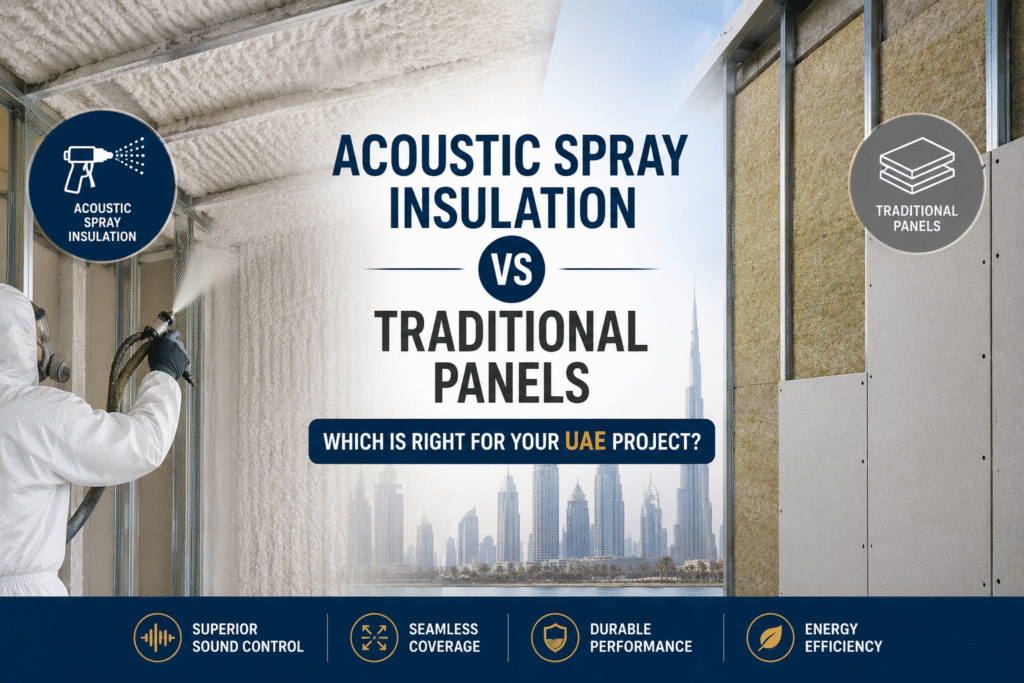
When most people think of acoustic treatment, they picture panels, rectangular, fabric-wrapped, fixed to a wall in a grid. And for many applications, that image is entirely appropriate. But the UAE construction landscape increasingly demands solutions that go beyond standard panel systems: curved ceilings, exposed concrete soffits, large-span industrial spaces, and heritage-sensitive interiors where visible panels would be architecturally intrusive.
This is where acoustic spray systems and plaster technologies have carved out a genuinely important niche. Understanding the differences, and, crucially, knowing which product category suits which project type, can save significant time, money, and post-installation regret.
What Acoustic Spray and Plaster Systems Actually Are
Acoustic spray systems are materials applied directly to surfaces — walls, ceilings, soffits, domes — using mechanical or manual application methods. They cure to form a seamless, continuous acoustic layer that absorbs sound across a range of frequencies. The most established products in this category include Monoglass (a spray-applied fiberglass insulation developed in 1979), which offers both thermal and acoustic performance, and Acowhite acoustic plaster, which creates a smooth, white, jointless surface that looks identical to standard painted plasterwork while delivering meaningful sound absorption.
Traditional acoustic panels, by contrast, are prefabricated units — typically consisting of an absorbent core (rockwool, polyester fibre, wood wool) wrapped in fabric or perforated wood — that are fixed to walls or suspended from ceilings as discrete elements.
Where Acoustic Spray Systems Have a Clear Advantage
Curved and irregular surfaces are the most obvious use case. Domes, arched ceilings, barrel vaults, and complex geometric forms are simply not suitable for standard rectangular panels. Acoustic spray and plaster systems follow the contour of any surface, meaning the entire area contributes to absorption rather than only the flat sections where panels can be mounted. This makes them the go-to solution for mosques, auditoriums, airport terminals, and luxury residential interiors with curved architectural features — all prominent in UAE construction.
Exposed structure and industrial aesthetics are another strong use case. Where architects want to leave concrete soffits, steel decking, or raw structural elements visible, traditional panels are often aesthetically incompatible. Monoglass spray applied directly to the underside of a structural deck maintains the industrial look while controlling the reverberation that would otherwise make the space acoustically uncomfortable.
Large-volume spaces — warehouses, logistics facilities, sports halls, and manufacturing plants — benefit from spray application because the speed and coverage efficiency of spraying is far greater than installing individual panels across thousands of square metres. For industrial noise control projects in UAE free zones and industrial areas, spray systems significantly reduce installation time and labour cost.
Seamless fire-rated finishes are an important consideration in UAE projects, where Civil Defence requirements are stringent. Both Monoglass and Acowhite carry fire ratings compatible with UAE Civil Defence requirements, and their continuous, jointless application eliminates the fire-spread risk associated with panels that have visible gaps or edges.
Where Traditional Acoustic Panels Remain the Better Choice
Targeted absorption in specific frequency ranges is where panels offer more flexibility. The acoustic performance of a panel — particularly its bass absorption and its NRC (Noise Reduction Coefficient) at different frequencies — can be precisely tuned by varying the core material thickness, density, and the air gap behind the panel. For recording studios, broadcast facilities, home theatres, and critical listening environments in the UAE, this tunability is valuable in a way that spray systems generally cannot match.
Aesthetic design freedom is another panel strength. Fabric-wrapped panels from suppliers like DBFABB come in virtually unlimited colours, textures, and custom print options. Perforated and slatted wooden panels from Prenpanel offer a warmth and material richness that spray systems cannot replicate. For premium hospitality interiors, retail environments, and corporate offices in the UAE where acoustic treatment is also expected to contribute to the interior design statement, panels often win.
Retrofit and tenant fit-out projects favour panels for practical reasons. Installing spray systems in an occupied or partially occupied building requires masking, containment, and curing time. Panels can be installed room by room with minimal disruption, making them the more practical choice for office refurbishments, hotel room upgrades, and clinic fit-outs.
A Combined Approach Is Often the Answer
In practice, the most acoustically effective and architecturally sensitive projects in the UAE often combine both approaches. A mosque might use acoustic plaster on the dome and upper curved walls, with discreetly patterned fabric panels at worshipper-level on the side walls. A hotel lobby might use spray on the concrete soffit above the reception desk, with bespoke fabric baffles suspended in the double-height atrium. An auditorium might apply Monoglass to the rear wall and use wooden diffusion panels at the sides.
The right combination depends on the acoustic brief, the architectural intent, the installation programme, and the budget. Acoustic Dubai supplies and installs both systems across the UAE and GCC, and can carry out acoustic modelling to determine the optimum specification before a single product is ordered. If you are unsure which approach suits your project, that conversation is always worth having early — ideally at design stage, before surface finishes are committed.