
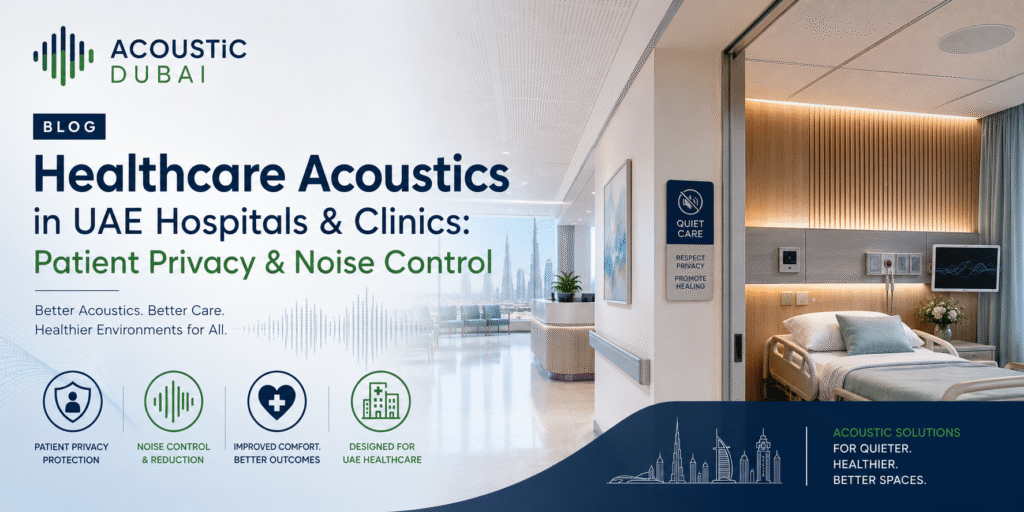
There is a detail about healthcare environments that rarely makes it into design briefs but that patients notice immediately: noise. The beep of monitors through a curtain. A consultation being conducted just loudly enough to hear in the waiting room. The clang of trolleys echoing down a corridor at three in the morning. In a sector where trust, dignity, and recovery are paramount, poor acoustic design quietly undermines all three.
As the UAE continues its rapid expansion of healthcare infrastructure — new hospitals under DHA and DOH authority, specialist clinics in every major free zone, and large-scale medical cities in Abu Dhabi and Dubai — acoustic performance is moving from an afterthought to a compliance and quality benchmark. For facilities seeking JCI accreditation or HAAD licensing, acoustic privacy is no longer optional.
The Case for Better Healthcare Acoustics
The World Health Organisation has published guidelines recommending that background noise in hospital patient rooms should not exceed 35 dB(A) during the day and 30 dB(A) at night. In most UAE healthcare facilities, measured levels are significantly higher — often driven by HVAC systems, hard reflective surfaces, and the operational density of busy wards and corridors.
Beyond comfort, there are three specific acoustic outcomes that healthcare facilities in the UAE should be actively designing for:
Speech privacy in consultation rooms is the most legally and ethically sensitive. If a patient can hear a neighbouring consultation through the wall — or if their own conversation can be overheard in the waiting area — this constitutes a genuine breach of patient confidentiality. It erodes trust and, in the context of international accreditation standards, it is a finding that auditors take seriously.
Speech intelligibility for clinical communication is a safety consideration. In ICUs, operating theatres, and emergency departments, clear verbal communication between clinical staff is critical. Excessive reverberation in hard-surfaced clinical spaces degrades speech intelligibility and increases the cognitive load on staff who already operate under pressure.
Noise reduction for patient recovery has a measurable clinical basis. Research consistently shows that patients in quieter environments sleep better, require less pain medication, and recover faster. In a private healthcare market as competitive as the UAE, acoustic environment quality is also a differentiator that premium patients actively notice and value.
Key Acoustic Challenges in UAE Healthcare Buildings
UAE healthcare facilities share a set of common acoustic challenges rooted in both climate and construction norms:
- Hard finishes throughout: Infection control requirements demand smooth, wipeable surfaces. Ceramic tile, vinyl flooring, painted plasterboard, and glass — all acoustically reflective — dominate most clinical spaces. Without deliberate acoustic treatment, these environments are extremely reverberant.
- HVAC intensity: Year-round cooling in the UAE’s climate means mechanical systems run continuously and at high capacity. Noise breakout from ductwork, fan coil units in ceiling voids, and plant room transmission are among the most common complaints in UAE healthcare buildings.
- High-density floorplates: Modern UAE hospitals and polyclinics pack a large number of consultation rooms, treatment bays, and waiting areas into relatively compact floorplates. The acoustic separation between adjacent spaces — both for speech privacy and for managing clinical noise — requires careful wall and ceiling specification.
- Corridor noise distribution: Long, hard-surfaced corridors act as acoustic transmission channels, carrying noise from one end of a ward to the other. Acoustic ceiling treatment in corridors is a simple but often overlooked intervention.
Practical Acoustic Solutions for UAE Healthcare Settings
For consultation rooms and treatment areas, the priority is achieving adequate speech privacy. This is measured using the Speech Privacy Index (SPI) or, more commonly in international standards, the Speech Transmission Index (STI). Improving the Sound Transmission Class (STC) or Rw rating of partition walls — typically by adding mass-loaded barriers, resilient layers, or upgrading to acoustic-rated partition systems — is the primary lever.
Acoustic ceiling systems designed for healthcare environments are available in materials that meet both infection control requirements and acoustic absorption targets. Perforated metal ceilings with acoustic backing, for example, offer the cleanability of metal with meaningful sound absorption, making them suitable for clean room and clinical environments where standard fabric panels would not be appropriate.
HVAC noise control in healthcare settings requires a coordinated approach between the acoustic consultant and the MEP engineer. Sound attenuators in ductwork, anti-vibration mounts on fan coil units, and acoustic duct lining all contribute to reducing background noise levels in patient-facing areas.
For corridors and waiting areas, acoustic ceiling baffles and wall-mounted fabric panels can dramatically reduce reverberation time and improve the overall acoustic comfort of the space without requiring structural changes.
Designing for JCI and HAAD Compliance
Joint Commission International (JCI) standards include patient rights provisions that directly reference privacy — acoustic privacy in consultation and treatment areas is an expected outcome, not just a desirable feature. HAAD facility standards similarly reference appropriate sound levels in patient areas. For UAE healthcare developers and operators targeting these accreditations, commissioning an acoustic design review and post-construction measurement is a practical way to demonstrate compliance and avoid findings during the accreditation audit. Acoustic Dubai’s team works with healthcare architects, MEP consultants, and hospital operators across the UAE to deliver acoustic solutions that meet clinical performance requirements while navigating the specific material and regulatory constraints of the healthcare environment. Whether you are fitting out a new polyclinic in a Dubai free zone or upgrading an existing ward in Abu Dhabi, the acoustic baseline matters — and it is entirely achievable.