
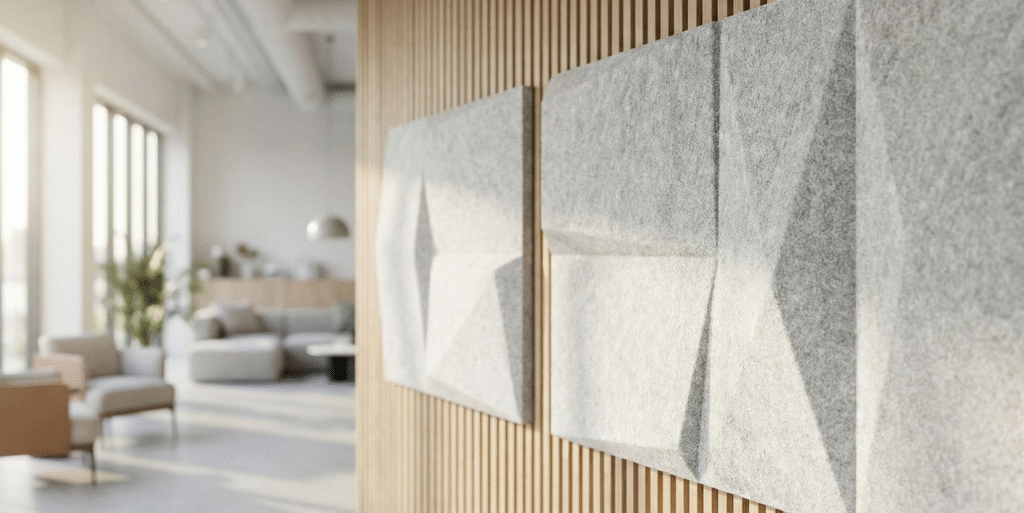
Among the diverse acoustic materials available today, polyester fiber panels have emerged as the performance leader for sound absorption across commercial, educational, hospitality, and residential applications. But what makes these panels so effective? Understanding the science behind pet polyester acoustic panels reveals why they consistently outperform traditional alternatives while offering additional benefits in sustainability, safety, and versatility.
The Physics of Sound Absorption
To understand how polyester fiber panels work, we must first understand sound absorption fundamentals. When sound waves encounter a surface, three things can occur: reflection (sound bounces back), transmission (sound passes through), or absorption (sound energy converts to heat).
Hard, dense surfaces like concrete, glass, or tile reflect most sound energy, creating echoes and reverberation. Soft, porous materials allow sound waves to enter, where friction within the material structure converts acoustic energy into minute amounts of heat, preventing the sound from reflecting back into the room.
Effective acoustic absorbers share key characteristics: they’re porous, allowing sound waves to penetrate; they have sufficient thickness to affect target frequencies; and they possess internal structure creating friction as sound waves move through the material.
Pet polyester acoustic panels excel in all these aspects, creating highly effective sound absorption across a broad frequency spectrum.
The Unique Structure of Polyester Fiber Panels
Polyester fiber panels are manufactured from recycled PET (polyethylene terephthalate) plastic, typically post-consumer bottles, processed into fibers and formed into dense, rigid panels through heat and pressure.
This manufacturing process creates a three-dimensional network of interlocking polyester fibers. Unlike woven fabrics with regular, predictable structure, these fiber networks feature random orientation and varying fiber-to-fiber contact points, creating an ideal acoustic absorption environment.
Sound waves entering this fiber matrix encounter countless tiny air pockets between fibers. As sound energy forces air to move through these microscopic channels, friction between moving air and fiber surfaces dissipates acoustic energy as heat. The more complex and dense the fiber network, the more effective this energy conversion becomes.
The manufacturing process controls panel density, which directly affects acoustic performance. Standard panels typically feature densities of 200-240 kg/m³, while high-performance variants may reach 300+ kg/m³ for applications requiring maximum absorption, particularly at lower frequencies.
NRC Ratings: Measuring Absorption Performance
Acoustic panels are rated using the Noise Reduction Coefficient (NRC), a single number representing average sound absorption across key frequencies (250Hz, 500Hz, 1000Hz, and 2000Hz). NRC values range from 0 (complete reflection, no absorption) to 1.0 (complete absorption, no reflection).
Quality pet polyester acoustic panels consistently achieve NRC ratings of 0.85-1.00, placing them among the highest-performing acoustic materials available. Some specialized polyester products achieve NRC ratings exceeding 1.00 through optimized fiber composition and panel architecture.
These high NRC values translate to real-world performance: a panel with NRC 0.90 absorbs 90% of sound energy striking its surface across the tested frequency range, reflecting only 10% back into the room. Compare this to materials like heavy curtains (NRC 0.40-0.50) or carpet (NRC 0.30-0.40), and the performance advantage becomes clear.
Frequency Response and Panel Thickness
While NRC provides a useful overall performance indication, acoustic engineers also consider how materials perform across different frequencies. Low frequencies (bass sounds) prove more challenging to absorb than high frequencies (treble sounds).
Sound absorption typically increases with material thickness. Thin materials (6-9mm) primarily absorb high frequencies, while thicker materials (20-25mm+) effectively absorb both high and low frequencies.
Acoustic Dubai by Akinco offers polyester panels in multiple thicknesses (9mm, 12mm, 25mm, and beyond), allowing precise specification for different acoustic challenges. Conference rooms prioritizing speech clarity might use 12mm panels optimized for vocal frequencies, while music venues require 25mm+ panels addressing the full frequency spectrum, including bass.
Advanced polyester panels may incorporate layered density designs—softer, more open fiber structure near the surface transitioning to denser material toward the backing, creating optimized frequency response across the audible spectrum.
Air Gap Installation and Enhanced Performance
A powerful technique for enhancing polyester panel performance involves installing them with an air gap between the panel and the wall or ceiling substrate. This gap creates a resonant cavity that significantly improves low-frequency absorption.
The science behind this improvement involves quarter-wavelength resonance. When sound waves encounter the panel, some energy passes through into the air gap. Low-frequency waves with wavelengths matching four times the gap depth resonate within this cavity, converting more energy to heat through friction and panel vibration.
Typical air gaps of 25-100mm can improve low-frequency absorption by 30-50%, making standard-thickness panels perform like much thicker materials at problem frequencies. This technique proves particularly valuable where space constraints limit using very thick panels.
Material Density and Acoustic Effectiveness
Panel density represents one of the most critical factors determining acoustic performance. Higher density creates more fiber-to-fiber contact points, increasing friction and sound energy conversion.
However, density must be optimized rather than maximized. Extremely dense materials become less porous, preventing sound waves from penetrating the panel and reducing absorption effectiveness. The ideal density allows sound entry while providing sufficient internal friction for energy conversion.
Quality pet polyester acoustic panels are engineered to optimal densities for their intended applications. General-purpose panels typically feature 200-240 kg/m³ density, while specialized high-performance variants may reach 280-320 kg/m³ for demanding applications requiring maximum absorption.
Advantages Over Traditional Acoustic Materials
Polyester fiber panels achieve superior sound absorption while offering benefits traditional materials cannot match:
Fiberglass Comparison: While fiberglass achieves comparable NRC ratings, polyester fiber panels eliminate health concerns from airborne glass particles. They’re safer to handle, install, and occupy spaces with, particularly important for schools and healthcare facilities.
Mineral Wool Comparison: Polyester panels typically weigh 30-40% less than mineral wool equivalents, simplifying installation and reducing structural loading. They also resist moisture better, maintaining performance in humid environments where mineral wool may degrade.
Foam Comparison: Polyester dramatically outperforms acoustic foam in durability, fire safety, and acoustic performance. Quality polyester panels last 10-15+ years versus 2-4 years for foam, while achieving Class A fire ratings impossible for most foam products.
The Role of Surface Treatments
Some polyester fiber panels incorporate surface treatments, optimizing performance for specific applications. Micro-perforated facings can enhance high-frequency absorption while protecting the fiber surface from dust and damage. Resin treatments may increase panel rigidity for applications requiring structural strength while maintaining acoustic properties.
These treatments must be carefully engineered; improper surface treatments can seal the panel surface, preventing sound penetration and eliminating acoustic benefit. Reputable manufacturers test treated panels to verify acoustic performance meets specifications.
Sustainability Meets Performance
A remarkable aspect of polyester fiber panel technology is achieving superior acoustic performance using recycled materials. Modern pet polyester acoustic panels contain 60-85% post-consumer recycled content, primarily from plastic bottles, without compromising acoustic effectiveness.
This demonstrates that sustainability and performance aren’t competing priorities, advanced engineering allows materials to excel in both dimensions simultaneously.
Frequently Asked Questions
1. What NRC rating should I look for in polyester acoustic panels?
For meaningful acoustic improvement, select polyester panels with a minimum NRC 0.85. High-quality panels achieve NRC 0.90-1.00, providing excellent sound absorption across most applications. Verify ratings through independent testing rather than manufacturer claims alone.
2. How does panel thickness affect sound absorption performance?
Thicker panels absorb lower frequencies more effectively. 9-12mm panels work well for speech frequencies in offices and classrooms. 20-25mm panels better address full frequency spectrum including music and bass sounds. Very low frequencies may require 50mm+ thickness or air-gap installation techniques.
3. Are polyester fiber panels as effective as fiberglass for acoustics?
Yes, quality polyester fiber panels match or exceed fiberglass acoustic performance (both achieve NRC 0.85-1.00) while eliminating health concerns from airborne glass particles. Polyester is safer to handle, install, and maintain, making it the superior choice for most applications.
4. Can polyester acoustic panels absorb low-frequency bass sounds?
Standard polyester panels (12-25mm) provide moderate low-frequency absorption. For enhanced bass absorption, use thicker panels (50mm+), install with air gaps creating resonant cavities, or specify layered-density designs optimized for low-frequency performance.
5. Do polyester fiber panels lose acoustic performance over time?
No, quality polyester fiber panels maintain acoustic performance throughout their 10-15+ year service life. Unlike foam that deteriorates or mineral wool that may settle and compress, polyester’s thermally-bonded fiber structure remains stable, preserving acoustic properties indefinitely.
6. How do I verify acoustic panel performance claims?
Request independent laboratory test reports showing NRC ratings and frequency-specific absorption coefficients. Reputable manufacturers provide testing from recognized laboratories following ASTM C423 or ISO 354 standards. Be skeptical of claims lacking documented third-party verification.